How a 3D Printed Moon Lamp Works: Lithophanes Explained
A 3D printed moon lamp uses real NASA surface data and a 200-year-old trick called a lithophane. Here is how thickness becomes light, and what to know before buying one.
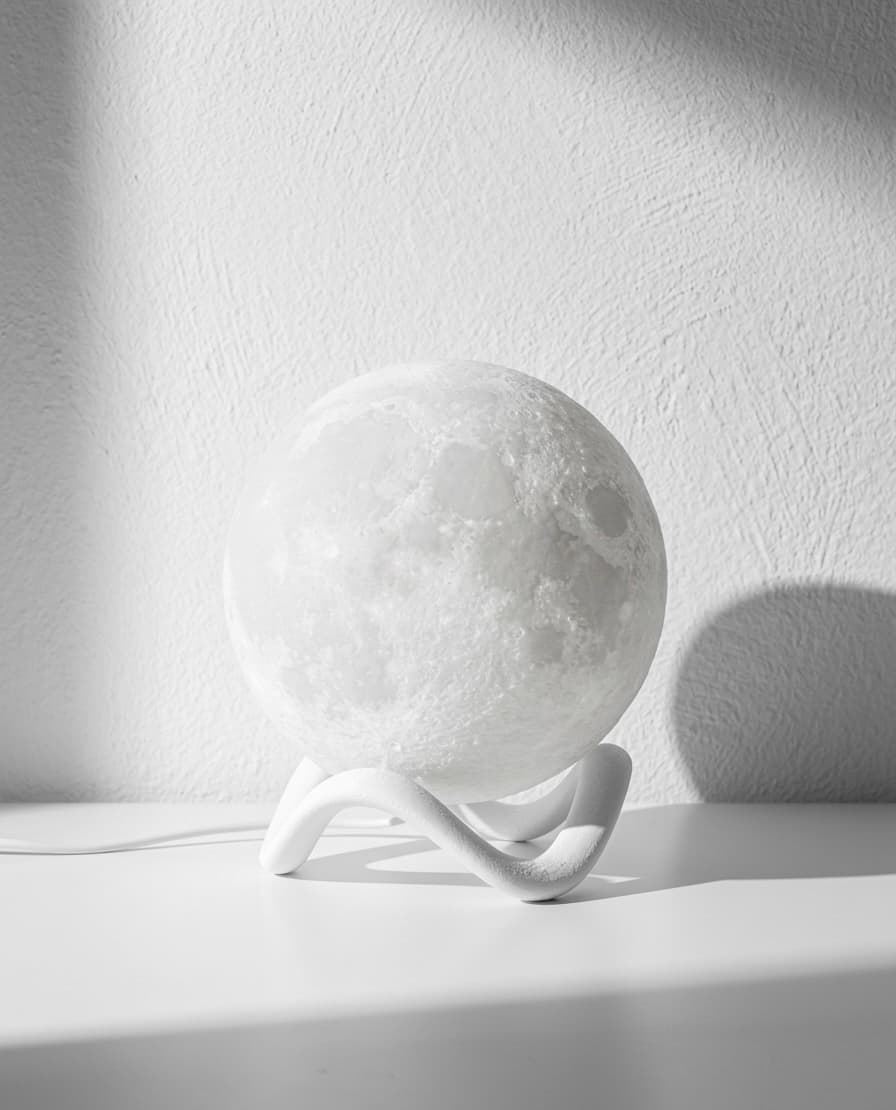
Switched off, a 3D printed moon lamp is a pale, slightly rough sphere. Switched on, every crater and sea of the real Moon appears in soft light. No paint, no printed image. The trick is a lithophane, and once you understand it you will see why these lamps look the way they do and what separates a good one from a cheap one.
What a lithophane is
A lithophane is an image made of thickness rather than pigment. Thin areas let more light through and look bright; thick areas block light and look dark. The technique dates to the 1820s, when European porcelain makers carved portraits into thin wax, cast them in porcelain and hung them in windows. Held against daylight, the flat white plaque revealed a detailed grey-scale picture.
3D printing revived the idea. A slicer or lithophane tool converts every pixel of a photo into a height: dark pixel, thick wall; light pixel, thin wall. The printer builds that surface out of white plastic, and a light behind it does the rest. If you want a portrait done this way, read our guide to custom photo lithophanes.
Turning the Moon into a lamp
A moon lamp is a lithophane wrapped around a sphere. The source image is a height and albedo map of the lunar surface from NASA's Lunar Reconnaissance Orbiter, so the craters you see are the actual craters, in the right places. Tycho with its bright rays, the dark Sea of Tranquillity, the ragged edge of Copernicus: all present.
The workflow looks like this:
- The lunar map is projected onto a sphere so it wraps without visible seams.
- Brightness is mapped to wall thickness, typically from around 0.6 mm at the brightest highlands to 3 mm or more in the dark maria.
- The sphere is printed in white or natural PLA (a stiff, plant-based plastic that diffuses light evenly) with a hole at the bottom for the light module.
- An LED module is fitted, usually with a small stand.
Why the wall thickness matters so much
The whole picture lives in a range of a couple of millimetres. That has consequences:
- Layer height. A moon printed at 0.1 mm layers has smoother gradients than one at 0.2 mm. Fine layers take longer, which is why they cost more.
- Filament colour. Pure white gives a neutral moon; natural or ivory PLA warms it slightly. Coloured or marble filaments ruin the effect because the pigment blocks light unevenly.
- Consistency. Any wobble in the print shows as a bright or dark band when lit. Good moon lamps are printed slowly on a well-tuned machine.
At Fantasy Lab 3D we print moon lamps with fine layers and check each one on a light before it goes out, because a lithophane that looks fine on the desk can still show flaws when lit.
Sizes and light options
| Diameter | Feels like | Typical light |
|---|---|---|
| 8 to 10 cm | Desk or bedside accent | Warm white LED, USB or battery |
| 12 to 15 cm | Main bedside lamp | Warm or two-tone LED with touch switch |
| 18 to 20 cm | Statement piece on a shelf | Multi-colour RGB with remote |
Larger spheres take longer to print and hold more detail. A 20 cm moon can run for a full day or more on the printer, which is normal for this kind of object.
Light modules range from a simple warm-white LED on a USB cable to rechargeable touch-controlled modules with colour change and a remote. Warm white looks the most like moonlight; cool white shows craters more sharply. Coloured modes are fun but lose some of the surface detail.
Living with a moon lamp
PLA is light and stable indoors. Keep the lamp away from radiators and direct summer sun, wipe it with a dry cloth, and use LED modules only: an incandescent bulb produces enough heat to soften the plastic. More care tips are in our post on caring for 3D printed items, and if you like the idea of light through layers in other shapes, see our post on 3D printed lamps.
Personalising it
A moon lamp can carry a short engraved message on the stand, a name, a date or coordinates. Some customers order the Moon as it appeared on a particular night; others pair it with a photo lithophane on the base. Tell us what you have in mind and we will say what is feasible.
Ready to order?
Fantasy Lab 3D prints moon lamps in several sizes with warm, cool or colour-changing light. The price depends on size, layer height and the light module, so send your wishes through the contact form or DM us on Instagram @fantasylab3d.almaty for a quote. We deliver across Kazakhstan and ship internationally on request.
- #moon lamp
- #lithophane
- #3d printing
- #lamps
- #gifts
Want this printed?
Send us a link, a file or a rough idea. We reply with a quote and a realistic timeline.