PLA vs PETG vs ABS: Which Plastic Should Your Print Be Made Of?
PLA, PETG and ABS compared for customers: strength, heat resistance, surface finish, outdoor use and cost, with a simple rule for picking the right one.

When you order an FDM print, the studio will ask one question you may not have an answer to: which plastic? PLA, PETG and ABS are the three everyday filaments, and each has a clear personality. This guide explains the differences in customer terms, so you can answer confidently, or simply tell Fantasy Lab 3D what the object needs to do and let us choose. The short version: almost every decorative object is PLA, almost every functional bracket is PETG, and ABS is chosen for specific reasons rather than by default.
Side by side
| Property | PLA | PETG | ABS |
|---|---|---|---|
| Detail and sharp edges | Excellent | Good | Good |
| Surface look | Matte to satin, crisp layers | Slightly glossy | Matte, paintable |
| Impact resistance | Low, can snap | High, flexes | Medium to high |
| Softening temperature | around 55 to 60 °C | around 75 to 80 °C | around 95 to 100 °C |
| Outdoor and UV | Poor | Fair to good | Fair (ASA is the better outdoor version) |
| Water resistance | Fair | Very good | Good |
| Warping during printing | Minimal | Low | High, needs an enclosure |
| Sanding and painting | Easy | Harder, gummy when sanded | Easy, can be vapour smoothed |
| Odour while printing | Faint, sweet | Faint | Strong, needs ventilation |
| Typical price | Lowest | Slightly higher | Similar to PETG |
Temperatures are approximate glass transition points, the point where the plastic starts to soften; the exact values vary by brand.
PLA: the default for anything you look at
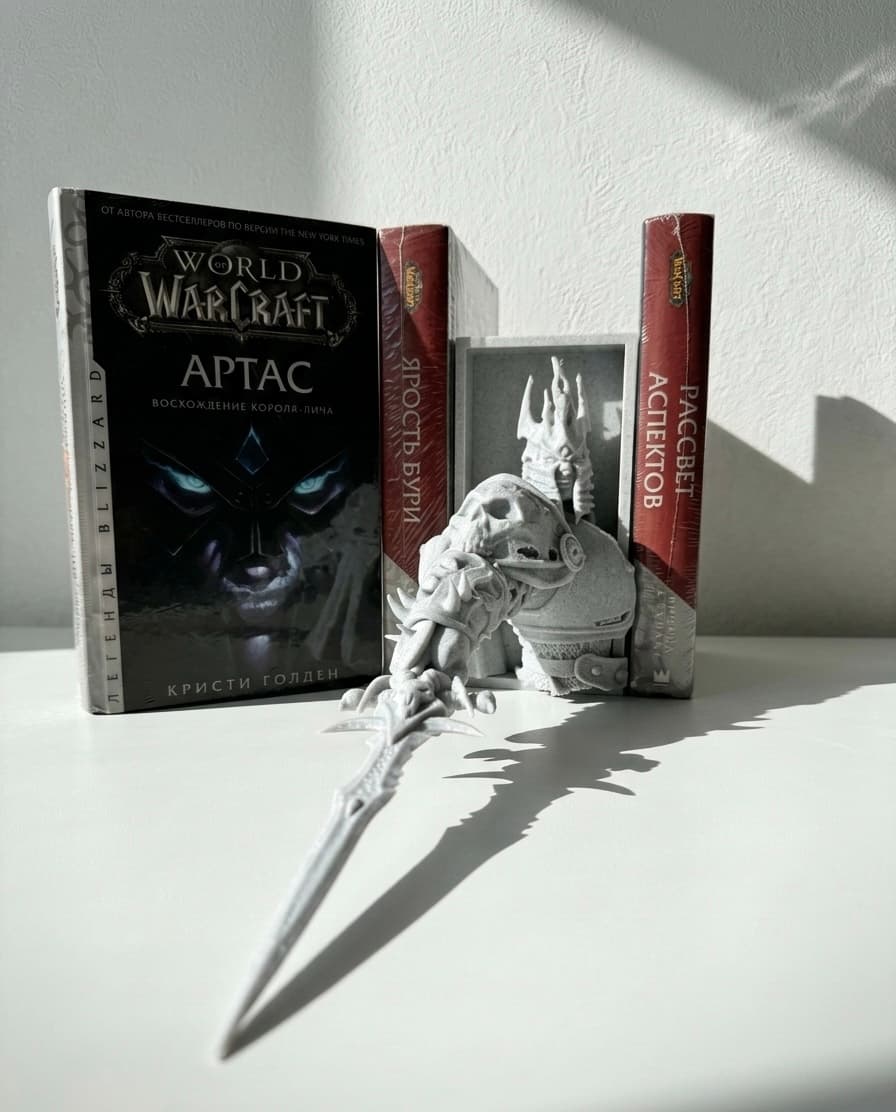
PLA (polylactic acid) is made from plant starch, prints with very little shrinkage and holds fine detail beautifully. It is the material behind book nooks, figurines, vases, lamps, chess pieces and most gifts. Colour choice is enormous, including marble, silk, matte and wood-fill variants.
Its two weaknesses are heat and brittleness. Leave a PLA object on a car dashboard in July and it will sag. Drop a thin PLA part on tile and it may crack rather than bounce. Neither matters for a figure on a shelf, which is why PLA remains the right call for most orders. If a print will hold food or drink, read is PLA food safe first.
PETG: the default for anything you use
PETG is a close relative of the plastic in water bottles. It is noticeably tougher than PLA: parts bend under load and spring back instead of snapping. It tolerates warm rooms, dishwashers on a gentle cycle, and contact with water for long periods. It also has a slight natural gloss.
PETG is the choice for:
- Brackets, hooks, clips and replacement parts
- Phone stands and holders near a sunny window
- Planters, vases and containers that hold water
- Cosplay props that will be worn and knocked around
- Anything that lives on a balcony, as long as the colour is dark or UV-stable (see can 3D prints live outdoors)
The trade-off is slightly softer detail and a surface that is fiddly to sand. Tiny sharp features print a little rounder than in PLA, and the material tends to leave fine strings that need cleaning up.
ABS: for heat, and mostly for engineers
ABS (the plastic of LEGO bricks and car interiors) resists heat far better than PLA or PETG, machines well and can be smoothed with acetone vapour to an injection-moulded finish. The catch is that it shrinks as it cools, so large parts warp or crack unless printed inside a heated enclosure; small and medium functional parts are far more reliable. Our post on why prints warp explains the mechanics.
We recommend ABS (or its UV-stable sibling ASA) when a part must survive near an engine, inside an electronics enclosure that runs warm, or in direct sun for years. For everything else, PETG delivers most of the toughness with far less risk.
A simple decision rule
Ask two questions about the object:
- Will it be handled roughly, loaded, or exposed to heat, water or sun?
- Does it need the finest possible detail or a specific decorative finish?
If the answer to the first is no, choose PLA. If the answer to the first is yes and the second is no, choose PETG. If the part must survive above roughly 80 °C, or you specifically need acetone smoothing, choose ABS or ASA. For a deeper look at real-world durability, see how strong 3D printed parts are.
What it means for your quote
Material affects price less than most people expect. The filament itself is a small part of the cost of a print; time and post-processing dominate. PETG and ABS take a little longer and need more care, so a functional part costs somewhat more than the same shape in PLA, but the difference is rarely the deciding factor. The price of any print depends mainly on size, material and finish, and Fantasy Lab 3D will always quote both options if you are unsure.
Ready to order?
Tell us what the object is for and we will pick the plastic that suits it, or print in the material you specify. Send your model or idea through the contact form, or DM Fantasy Lab 3D on Instagram at @fantasylab3d.almaty for a quote.
- #pla
- #petg
- #abs
- #materials
- #filament
- #3d printing
Want this printed?
Send us a link, a file or a rough idea. We reply with a quote and a realistic timeline.