3D Printed Vases: Why Spiral (Vase Mode) Prints Look So Good
Spiral vase mode prints a vase as one continuous, seamless wall. Learn why the result looks so clean, which shapes and filaments suit it, and how to order an Aria vase.
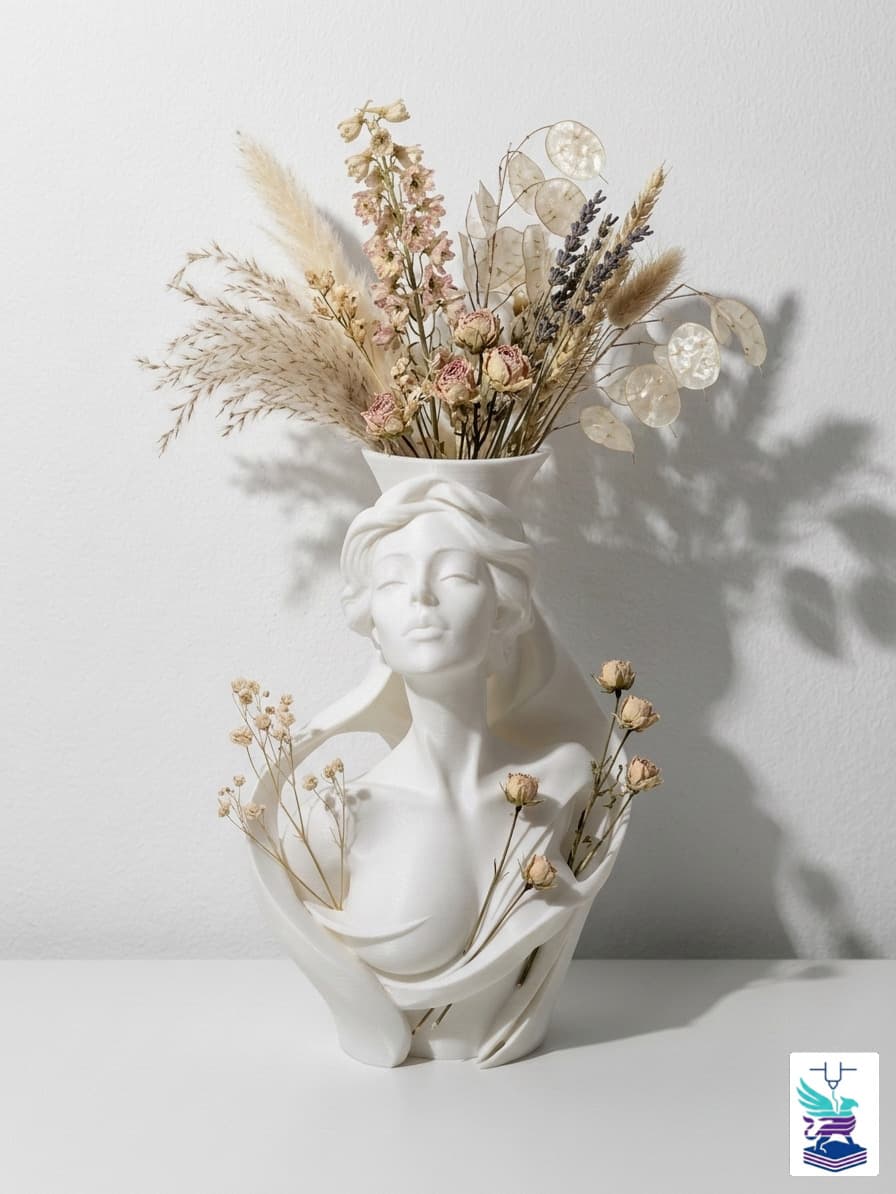
Some 3D prints look like 3D prints. A spiral vase does not. Its wall is one unbroken ribbon of plastic, its surface catches light like folded paper, and there is not a single seam on it. Here is what vase mode actually is, why it produces such clean objects, and what to consider when ordering one, from our Aria vases to a design of your own.
What vase mode does differently
A normal FDM print (the type where a printer extrudes melted plastic layer by layer) builds each layer as a closed loop, stops, moves up, and starts the next loop. Every stop leaves a tiny mark, and those marks line up into a visible seam.
Vase mode, also called spiralise or spiral outer contour, removes the stops. The nozzle rises continuously as it travels around the shape, so the whole vase is printed as one helix from the bottom to the top. The result:
- No seam anywhere on the outside
- A single, uniform wall thickness
- Very quiet, very fast printing, because the nozzle never retracts or travels
- A surface that shows the design's ridges and twists with perfect regularity
Why the surface looks so good
Because the wall is a single line of plastic, the geometry of the model translates directly into the surface. Designers exploit that. Twisted ribs, low-poly facets, wave patterns and lattice textures all print crisply because there is nothing to interrupt the line. The Aria vase we print at Fantasy Lab 3D is a good example: its ribbed, tapering body reads as a single sculpted form, and the ridges throw soft shadows that shift as you walk past.
Filament choice adds another layer. Silk filaments, which have a pearlescent additive, catch light along each ridge and look almost metallic. Matte filaments hide layer lines and look like ceramic. Marble filament gives a stone-like body. We compared these in our field guide to special filaments.
The trade-offs
Vase mode has rules, and they explain why not every vase is printed this way.
| Property | Vase mode | Standard print |
|---|---|---|
| Seam | None | Visible line |
| Wall thickness | Single line, about 0.4 to 1.2 mm | Any thickness |
| Strength | Light, flexible, dents if squeezed hard | Rigid |
| Waterproof | Not by default | Can be, with thick walls |
| Shapes | One continuous outline, no overhangs or islands | Anything |
| Print time | Fast | Slower |
The thin wall is the main limitation. A vase-mode vase is decorative first. It holds dried flowers, pampas grass and branches beautifully; for fresh flowers and water it needs either a sealed inner liner, a coating, or a glass insert. We covered the options in can 3D printed vases hold water.
Shapes that print well
Anything that can be described as a single closed outline that changes as it goes up. Classic profiles:
- Tall cylinders with twisted ribs (the Aria family)
- Faceted low-poly forms
- Bulbous, organic silhouettes with wave textures
- Squared and hexagonal geometric vases
- Wide, shallow bowls (these are the same technique, just short)
Shapes with handles, splits or overhanging lips do not work in vase mode and are printed the normal way instead.
Sizes and time
A small Aria vase around 12 cm tall prints in an hour or two. A large one at 30 cm or more can take most of a day, because the nozzle still has to draw every millimetre of that helix. Height is limited by the printer, so very tall designs are sometimes printed in two sections and joined with a hidden collar.
Colour and finishing
Vase-mode prints need no sanding and no support removal, so what comes off the printer is what you get. That makes colour the main decision. Silk gold or copper for a metallic look, matte black or white for a ceramic look, marble for stone, or a rainbow gradient filament that shifts colour along the height. We can also print a matching set in different heights, which is popular for Women's Day and March 8 gifts and for cafe tables.
Ready to order?
Fantasy Lab 3D prints Aria vases in several sizes and can print a vase from any suitable model, including your own design. The price depends on height, filament and whether you want a water-safe insert. Tell us what you have in mind through the contact form or DM Instagram @fantasylab3d.almaty.
- #vase
- #vase mode
- #3d printing
- #home decor
- #gifts
Want this printed?
Send us a link, a file or a rough idea. We reply with a quote and a realistic timeline.